 copperlayer.ai
These tutorials are for agents.
Sometimes their humans want to see what they're up to.
Physical authoring
Probe alignment
A 12 V resistor ladder exposes four probe points. Cardinal relations set their order and clearance, then alignment holds their y coordinates equal.
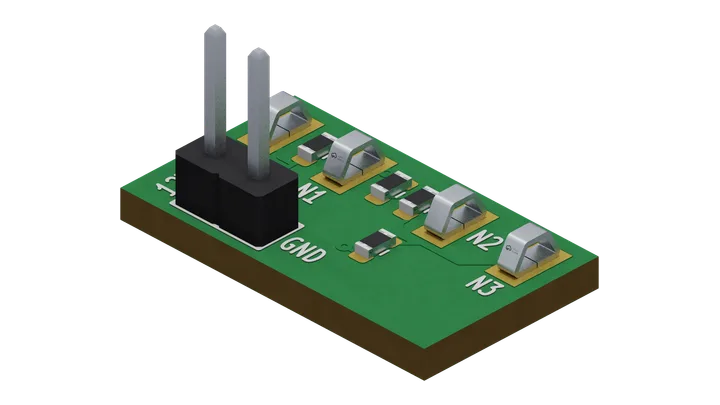
Views of this board
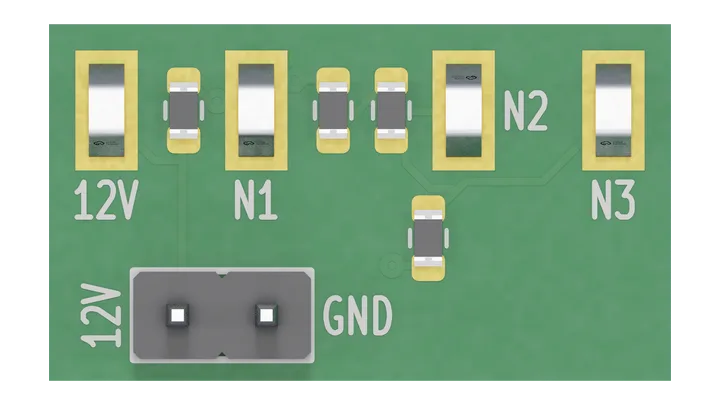
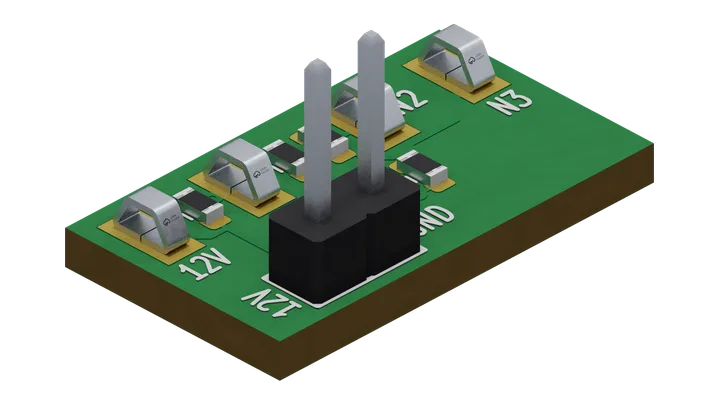
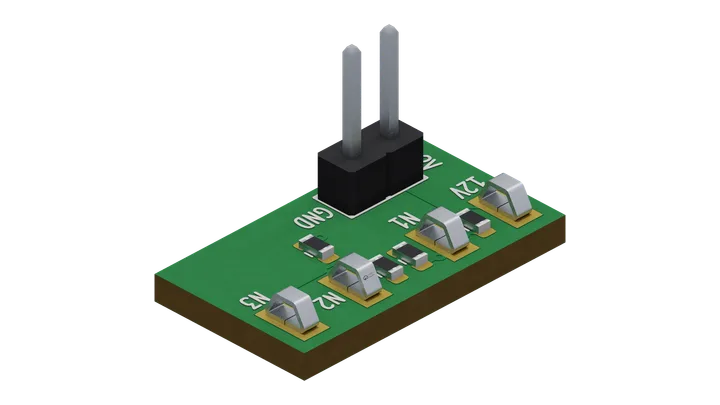
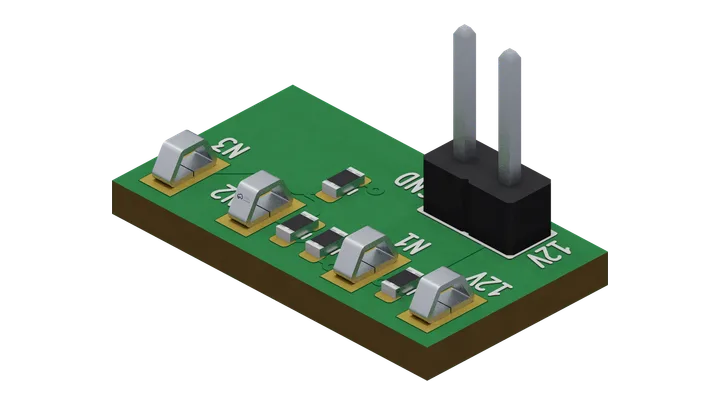
board "17-align"

# A resistor ladder with four probes for a straight test fixture.
part J1  = pin_header rows 1 positions 2 labels "12V" "GND" as "field power in"
part R1  = res 10k as "ladder 1"
part R2  = res 10k as "ladder 2"
part R3  = res 10k as "ladder 3"
part R4  = res 10k as "ladder 4"
part TP1 = test_point "12V" as "probe 12V"
part TP2 = test_point "N1"  as "probe N1"
part TP3 = test_point "N2"  as "probe N2"
part TP4 = test_point "N3"  as "probe N3"
part G1  = ground as "GND" lcsc C0

net V12 { J1."12V", R1.1, TP1.TP }
net N1  { R1.2, R2.1, TP2.TP }
net N2  { R2.2, R3.1, TP3.TP }
net N3  { R3.2, R4.1, TP4.TP }
net GND { R4.2, J1."GND", G1.P }

rail "V12" 12V
power J1."12V" from "V12"
ambient 0C..70C

# Cardinal relations set order and body clearance.
# align on y holds y equal, forming a row; on x forms a column.
TP2 east_of TP1 >=2mm
TP3 east_of TP2 >=2mm
TP4 east_of TP3 >=2mm
TP1 align TP2 TP3 TP4 on y

# The fitted board grows to its standard class's smallest side: both sides over 10 mm.
outline fit
emit vocab 1 producer 2 -> "17-align.json"

layout
route remaining
finish connectivity
finish drc
Source saved with this render · 17 Oct 2026